

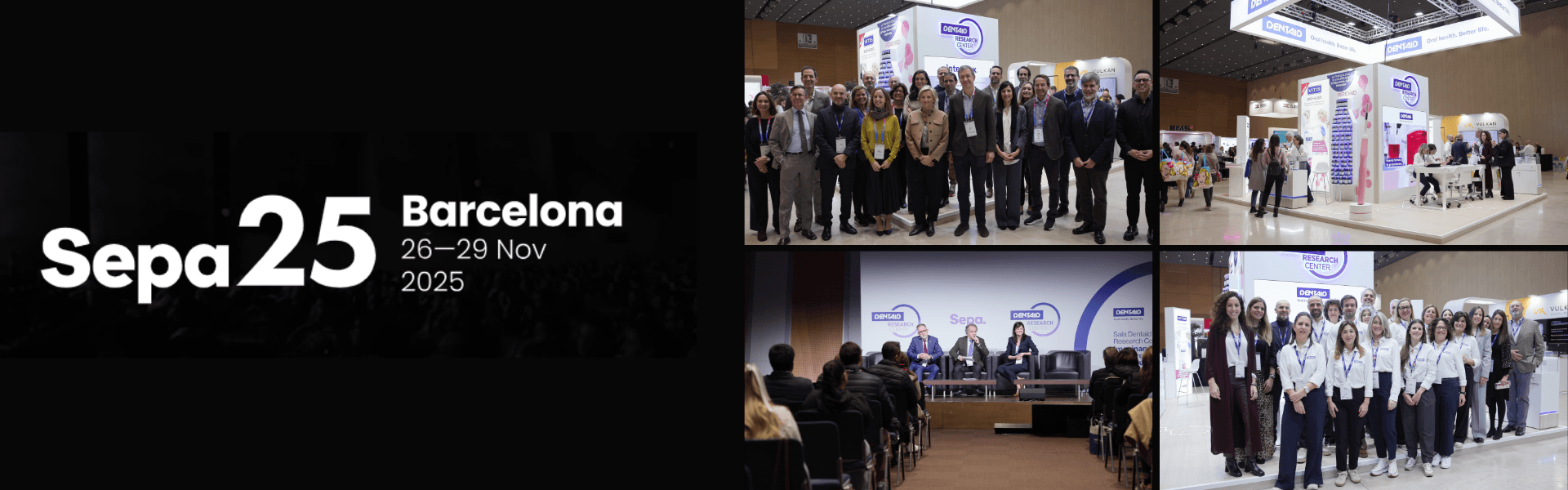
Under the banner “Imagining the Future of Oral Health”, the Dentaid Research Center Hall brought together more than 600 dental professionals for a full-day event as part of the SEPA Barcelona 2025 congress. This meeting highlights Dentaid's ongoing commitment to high-quality scientific dissemination, supporting the advancement of periodontics in Spain for decades.
Prevention in periodontal health plays a crucial role in maintaining overall oral health. In a context where periodontitis and caries remain two of the most prevalent oral diseases worldwide, effective control of the oral biofilm has become a key preventive strategy. With this focus, the event “Imagining the Future of Oral Health” was held as part of the official programme of the Spanish Society of Periodontology and Osteointegration (SEPA) congress in Barcelona. Promoted by the Dentaid Research Center, it brought together international leaders in periodontology, research and clinical practice for discussion and knowledge sharing.
Against this backdrop, the day began with a specialised discussion on tissue regeneration, moderated by Dr Juan Blanco. During the session, the latest developments and emerging therapeutic options were reviewed, featuring contributions from Dr Ana Castro, who explored the role and applications of autologous biomaterials, and Dr Nelson Pinto, who analysed the indications, benefits and limitations of using platelet-rich fibrin concentrates. This multidisciplinary exchange provided an up-to-date and evidence-based perspective on which techniques deliver the best results according to current research.
Peri-implant prevention: strategies for all phases of treatment
The experts delved into the concept of primordial prevention, aimed at identifying and controlling risk factors before dental implant placement. Dr Mariano Sanz, Professor of Periodontics at the Universidad Complutense de Madrid, during his panel discussion alongside Drs Elena Figuero, David Herrera, Filippo Grazianni and Ausra Ramanauskaite, stated that "Peri-implant health begins before the implant even exists. We must evaluate the quality and quantity of keratinised mucosa, implant position, restorative design, and, above all, the patient’s periodontal and systemic condition. Periodontal prevention is the foundation for reducing the future development of peri-implant diseases".
Furthermore, the expert panel highlighted surgical and maintenance strategies for controlling peri-implantitis, noting that surgery and maintenance are inseparable phases when seeking to ensure long-term implant success.
Antiseptics in periodontics and implant dentistry: a comprehensive, up-to-date perspective
The conference at the Dentaid Research Center Hall during SEPA Barcelona featured a round table dedicated to the use of antiseptics in the prevention and treatment of periodontal and peri-implant diseases. Participating experts reviewed the historical development of antiseptics, the latest scientific evidence, current controversies, and challenges in patient education and adherence, while also highlighting lines of future innovation being pursued at the Dentaid Research Center. Drawing on current consensus and guidelines, the session emphasised the importance of integrating antiseptics into a comprehensive, patient-centred approach to periodontal and peri-implant health, grounded in evidence.
Interproximal hygiene under discussion
Experts agreed that interdental spaces remain a critical site for bacterial plaque accumulation due to their anatomical complexity and limited accessibility. According to the evidence, interdental brushes are particularly effective at reducing dental biofilm and preventing periodontal and peri-implant diseases. However, optimal use requires selecting the appropriate size, providing proper patient instruction, and ensuring sustained adherence over time.
In this regard, Dr Cornelia Frese, a specialist in conservative and geriatric dentistry at Heidelberg University, Germany, stressed the importance of continuing progress in both standardisation and personalisation: "When it comes to cleaning effectiveness, the size of the interdental brush is crucial. If it is too small, it cannot reach key areas; if it is too large, it can cause tissue trauma. Choosing the right brush is not as simple as it may seem, as it requires considerable clinical experience and a good sense of touch to feel the resistance of the model. In my opinion, the interproximal brush is not reliable enough on its own".
Dr Joan Gispert, R&D&I Director at the Dentaid Research Center, highlighted: "Research is the cradle of knowledge, and being able to share and discuss that knowledge with the international scientific and medical community gives us a unique opportunity to explore synergies with the world’s leading oral health experts. Having multidisciplinary teams to work on the main lines of research, and creating a space for exchanging ideas, such as the Dentaid Research Center Hall at SEPA, allows us to continue generating knowledge with those who share our commitment to people's health".
A total of 21 experts contributed to the content sessions that made up the Dentaid Research Center Hall programme at SEPA BCN ’25, which were attended by more than 600 dental professionals.
The Sepa Barcelona 2025 congress set a record attendance, registering over 7,000 dental professionals.
Prevention in periodontal health plays a crucial role in maintaining overall oral health. In a context where periodontitis and caries remain two of the most prevalent oral diseases worldwide, effective control of the oral biofilm has become a key preventive strategy. With this focus, the event “Imagining the Future of Oral Health” was held as part of the official programme of the Spanish Society of Periodontology and Osteointegration (SEPA) congress in Barcelona. Promoted by the Dentaid Research Center, it brought together international leaders in periodontology, research and clinical practice for discussion and knowledge sharing.
Against this backdrop, the day began with a specialised discussion on tissue regeneration, moderated by Dr Juan Blanco. During the session, the latest developments and emerging therapeutic options were reviewed, featuring contributions from Dr Ana Castro, who explored the role and applications of autologous biomaterials, and Dr Nelson Pinto, who analysed the indications, benefits and limitations of using platelet-rich fibrin concentrates. This multidisciplinary exchange provided an up-to-date and evidence-based perspective on which techniques deliver the best results according to current research.
Peri-implant prevention: strategies for all phases of treatment
The experts delved into the concept of primordial prevention, aimed at identifying and controlling risk factors before dental implant placement. Dr Mariano Sanz, Professor of Periodontics at the Universidad Complutense de Madrid, during his panel discussion alongside Drs Elena Figuero, David Herrera, Filippo Grazianni and Ausra Ramanauskaite, stated that "Peri-implant health begins before the implant even exists. We must evaluate the quality and quantity of keratinised mucosa, implant position, restorative design, and, above all, the patient’s periodontal and systemic condition. Periodontal prevention is the foundation for reducing the future development of peri-implant diseases".
Furthermore, the expert panel highlighted surgical and maintenance strategies for controlling peri-implantitis, noting that surgery and maintenance are inseparable phases when seeking to ensure long-term implant success.
Antiseptics in periodontics and implant dentistry: a comprehensive, up-to-date perspective
The conference at the Dentaid Research Center Hall during SEPA Barcelona featured a round table dedicated to the use of antiseptics in the prevention and treatment of periodontal and peri-implant diseases. Participating experts reviewed the historical development of antiseptics, the latest scientific evidence, current controversies, and challenges in patient education and adherence, while also highlighting lines of future innovation being pursued at the Dentaid Research Center. Drawing on current consensus and guidelines, the session emphasised the importance of integrating antiseptics into a comprehensive, patient-centred approach to periodontal and peri-implant health, grounded in evidence.
Interproximal hygiene under discussion
Experts agreed that interdental spaces remain a critical site for bacterial plaque accumulation due to their anatomical complexity and limited accessibility. According to the evidence, interdental brushes are particularly effective at reducing dental biofilm and preventing periodontal and peri-implant diseases. However, optimal use requires selecting the appropriate size, providing proper patient instruction, and ensuring sustained adherence over time.
In this regard, Dr Cornelia Frese, a specialist in conservative and geriatric dentistry at Heidelberg University, Germany, stressed the importance of continuing progress in both standardisation and personalisation: "When it comes to cleaning effectiveness, the size of the interdental brush is crucial. If it is too small, it cannot reach key areas; if it is too large, it can cause tissue trauma. Choosing the right brush is not as simple as it may seem, as it requires considerable clinical experience and a good sense of touch to feel the resistance of the model. In my opinion, the interproximal brush is not reliable enough on its own".
Dr Joan Gispert, R&D&I Director at the Dentaid Research Center, highlighted: "Research is the cradle of knowledge, and being able to share and discuss that knowledge with the international scientific and medical community gives us a unique opportunity to explore synergies with the world’s leading oral health experts. Having multidisciplinary teams to work on the main lines of research, and creating a space for exchanging ideas, such as the Dentaid Research Center Hall at SEPA, allows us to continue generating knowledge with those who share our commitment to people's health".
A total of 21 experts contributed to the content sessions that made up the Dentaid Research Center Hall programme at SEPA BCN ’25, which were attended by more than 600 dental professionals.
The Sepa Barcelona 2025 congress set a record attendance, registering over 7,000 dental professionals.
Noticias Relacionadas
25% of Dental Implant Patients Suffer from Peri-Implant Diseases

28 Nov 2023

Cookie Policy
We use our own and third-party cookies to analyse website usage and display ads tailored to your preferences based on a profile created from your browsing habits (e.g., pages visited).
You can accept or reject all cookies, or customise your preferences.